A successful custom 3D acrylic night light depends on more than choosing an attractive graphic. OEM buyers need to control how the artwork is converted for laser engraving or cutting, the acrylic thickness and optical quality, the fit between the acrylic panel and lamp base, LED color and brightness, electrical configuration, surface finish, packaging and final inspection. Small changes in line width, engraving depth or base-slot dimensions can noticeably change the illuminated result. For private-label projects, the safest approach is to approve the complete illuminated sample rather than artwork, acrylic and electronics separately. The finished lamp should reproduce the intended pattern clearly, sit securely in its base, illuminate without distracting dark areas, and arrive without scratches or cracks after transport.
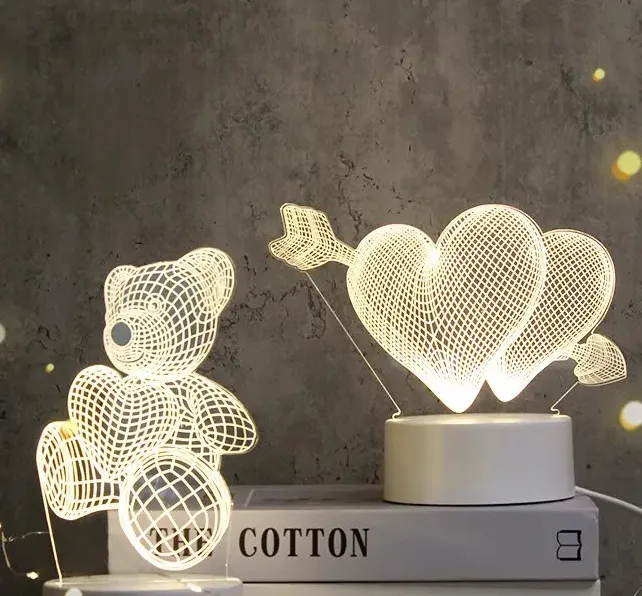
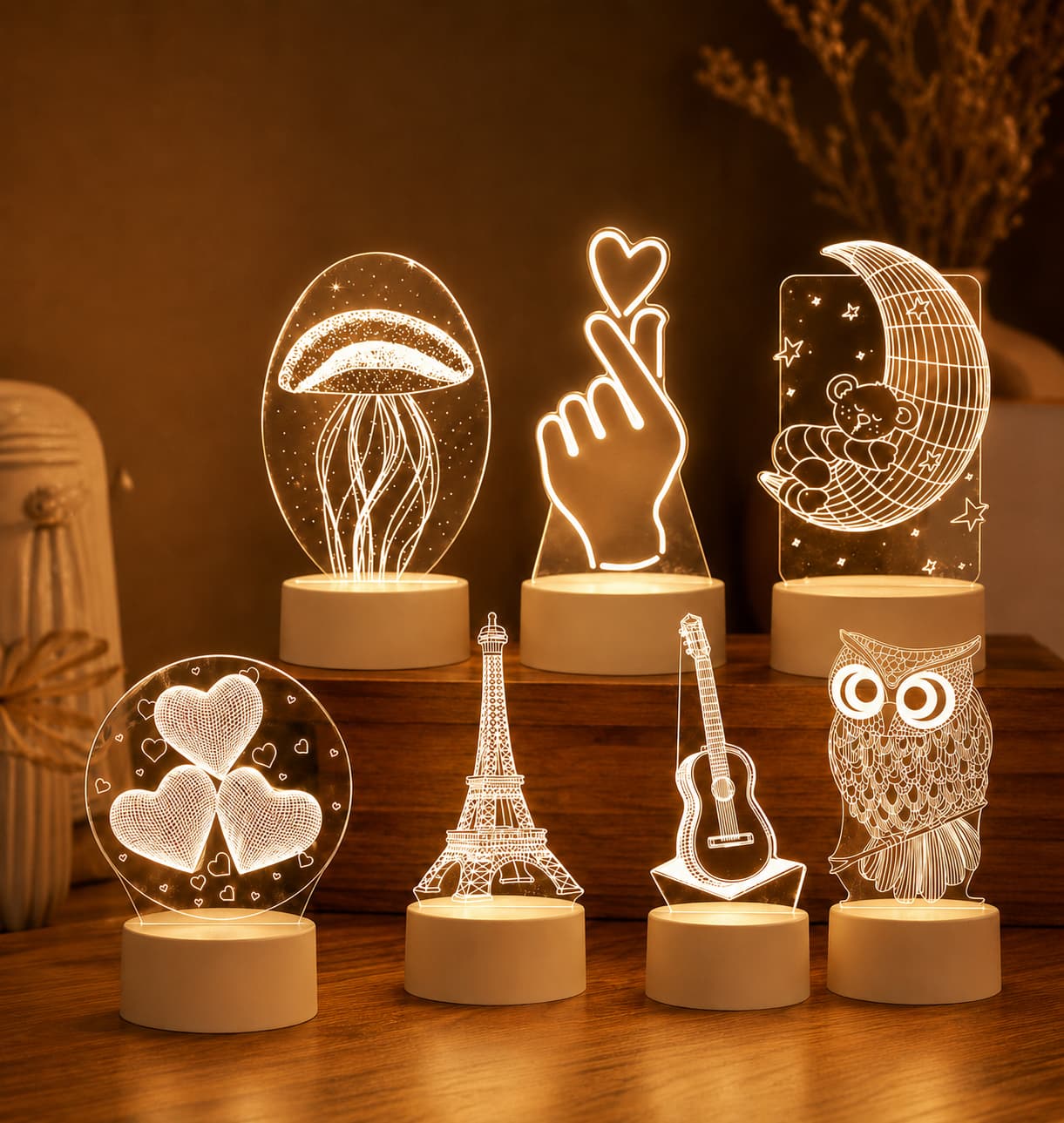
The “3D” effect in an acrylic night light is usually created visually rather than by producing a fully three-dimensional object. Lines, contours or layered graphic elements are engraved or cut into transparent acrylic, and light entering through the edge highlights those features. LYD’s current 3D acrylic night light uses laser-cut acrylic with LED illumination and a natural wood base. Its existing product is positioned as a compact decorative lamp with a soft ambient effect.
For OEM artwork, buyers should provide vector files whenever possible. The artwork review should check:
Minimum line width
Distance between engraved features
Overall panel dimensions
Logo and text placement
Cutting outline
Engraving versus printed areas
Orientation when inserted into the base
Required illuminated and non-illuminated zones
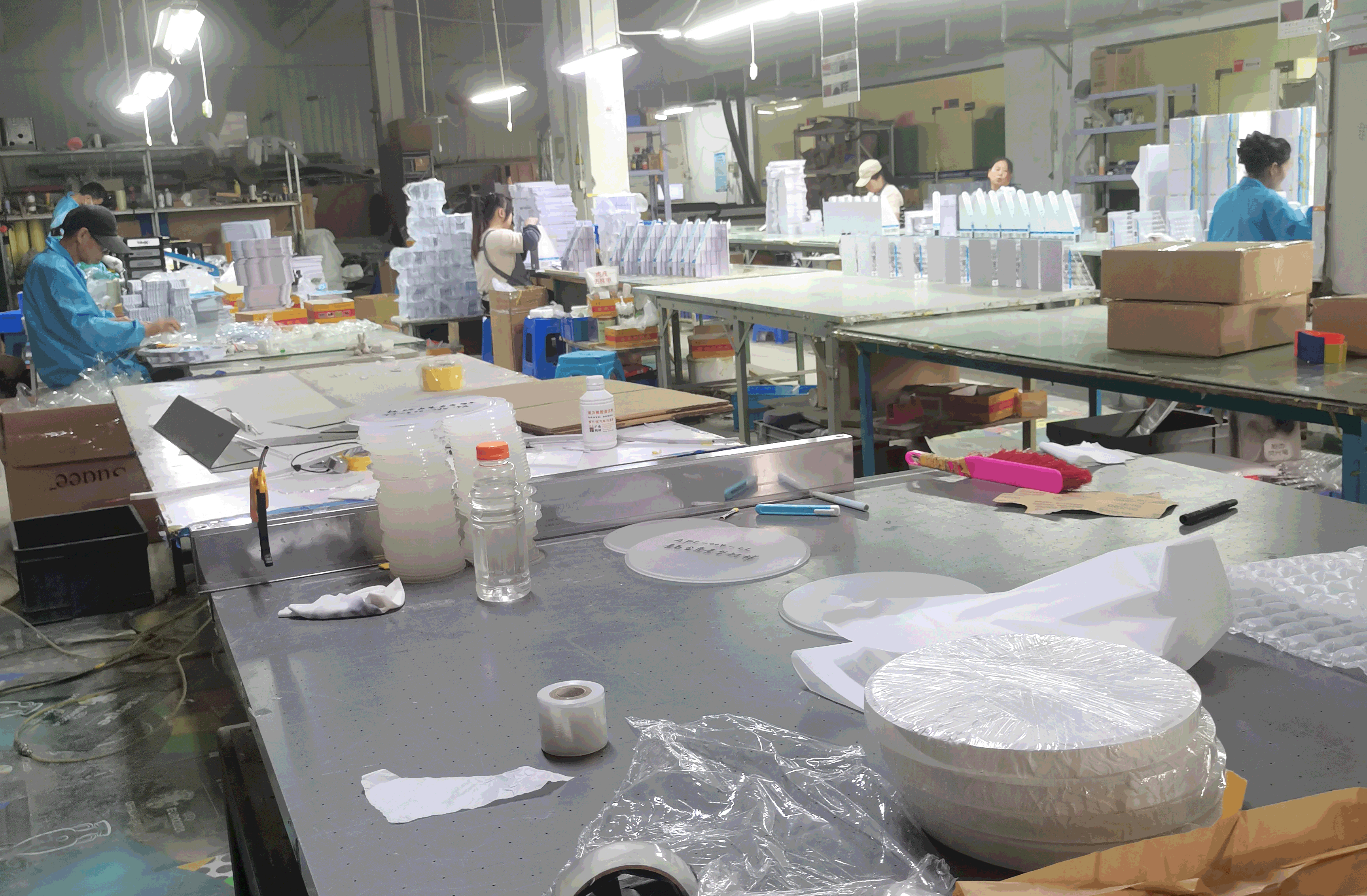
A highly detailed illustration may look good on a computer screen but become crowded after engraving into a small acrylic panel. Fine facial features, thin typography and closely spaced lines should therefore be tested at actual production size. The illuminated prototype is especially important because the same artwork can look different in daylight and when edge-lit. Ask the supplier to approve both an unlit appearance and a dark-room illuminated appearance before mass production. If the project uses full-color graphics instead of engraving alone, clarify whether UV printing, screen printing or another decoration method will be used. LYD lists laser cutting, laser engraving and UV printing among its in-house acrylic and LED processing capabilities.
Acrylic is not simply a transparent holder for the image. Its optical and mechanical properties directly affect how the night light looks.
Transparent acrylic should be specified by thickness tolerance, surface condition, color, clarity and edge finish. ISO 13468-1 provides a standardized method for measuring total luminous transmittance of transparent plastics, while ASTM D1003 covers haze and luminous transmittance. These standards are useful when optical clarity needs to be specified objectively rather than described only as “high transparency.”
For a custom acrylic night light, buyers should pay particular attention to three areas. Panel thickness: The sheet must fit the base slot correctly. If it is too thin, the panel may lean or move; if it is too thick, insertion may damage the acrylic or base.
Engraved surface: The engraved lines should be clear enough to intercept edge light, but engraving should not make thin areas fragile.
Edges: Cutting marks, chips or inconsistent polishing can reduce the perceived quality of a transparent product.
Protective film should normally remain on acrylic surfaces through cutting and handling for as long as the process allows. The finished product should then be inspected under strong side lighting because fine scratches are often easier to see at an angle than directly from the front. Buyers developing a broader acrylic product range can also review LYD’s Acrylic Displays products, where customization includes size, branding, laser engraving and other acrylic-processing options.
The base performs three jobs: holding the panel, positioning the light source and housing the electrical components. Start with the slot. Its width should match the finished acrylic thickness closely enough to hold the panel upright without requiring excessive insertion force. The base should also remain stable when the acrylic panel reaches its maximum approved height. Next, specify the LED configuration.
Questions to confirm include:
Warm white, cool white or RGB
Target color temperature
Fixed color or color-changing mode
Touch, button or remote control
Dimming requirement
USB or adapter power
Battery requirement
Cable length
Plug type for the destination market
LYD’s current reference product is listed with 2700K warm white, a natural wood base, USB power configuration and DC 6V input. These are useful reference specifications, but custom projects should confirm the final electrical design in the approved production specification rather than assume every OEM version uses the same configuration. Illumination uniformity also deserves attention. The lower engraved areas closest to the LED may naturally appear brighter than features farther away. Artwork density, panel height and LED placement should therefore be evaluated together.
For projects requiring a more decorative illuminated product rather than an edge-lit night light, LYD’s art neon lighting collection provides another OEM route using acrylic plates, LED neon flex and customizable colors or graphics. Visible LED products should also be assessed for optical safety where relevant. IEC 62471 establishes a framework for evaluating photobiological hazards from lamps and lamp systems, including LEDs, while IEC 62471-7 addresses products predominantly emitting visible radiation.
| OEM Item | What to Specify | What to Check on Sample |
|---|---|---|
| Artwork | Vector file, size, line width, engraving areas | Detail clarity when illuminated |
| Acrylic | Material, thickness, dimensions, edge finish | Scratches, chips, flatness |
| Base | Wood/plastic material, slot size, finish | Panel fit and stability |
| LED | CCT/RGB, brightness, control mode | Uniformity and color consistency |
| Power | Voltage, USB/adapter, cable, plug | Stable operation and connector fit |
| Branding | Logo, engraving, printing, label | Position and color accuracy |
| Packaging | Inner protection, retail box, carton | Scratch and impact protection |
| QC | Golden sample and tolerances | Production consistency |
Packaging deserves more attention than many buyers give it. Acrylic panels can be scratched even when they do not break, and the protruding panel shape can create concentrated loads inside the retail box. A practical packaging structure may include surface protection for the acrylic, an individual bag, shaped foam or paper insert, separate restraint for the base and cable, retail box and outer shipping carton. For e-commerce or parcel distribution, the packaged product can be evaluated using an appropriate transport-test protocol. ISTA 3A, for example, is intended for individual packaged products moving through parcel-delivery systems, while ISTA recommends retesting when meaningful changes are made to the product, package or process. Before bulk production, approve a golden sample that includes the final artwork, acrylic thickness, base, LEDs, cable, branding and packaging. Random production inspection should compare mass-production units against this complete reference rather than approving components independently.
Vector artwork such as AI, EPS, SVG or editable PDF is generally preferable for laser cutting and engraving because curves and lines can be scaled without losing edge definition. The supplier should still review minimum line width and actual production dimensions before cutting.
No. Thickness affects rigidity, weight, edge-light behavior and the required base-slot size. The correct thickness should be selected around the panel dimensions and base construction rather than simply choosing the thickest available sheet.
Yes. Logos, text and graphic outlines can be incorporated through engraving, cutting or printing depending on the required visual effect. A pre-production illuminated sample is advisable for small lettering and detailed logos.
Neither is universally better. Warm white can suit bedroom, gift and minimalist décor products, while RGB is useful when color-changing effects are part of the product concept. The choice should follow the intended customer and design.
Check artwork accuracy, acrylic dimensions, engraving clarity, scratches, base fit, illumination uniformity, LED color, controls, cable and connector quality, labels, packaging and the complete illuminated appearance.
Provide artwork, acrylic dimensions and thickness, base material, LED color or CCT, control mode, power supply, branding method, packaging requirements, destination market, quantity and any required safety or transport testing.
Contact us for OEM inquiries.
ISO — ISO 13468-1:2019, Plastics: Determination of Total Luminous Transmittance — standardized measurement of visible-light transmission through transparent plastics.
IEC — IEC 62471:2006, Photobiological Safety of Lamps and Lamp Systems — evaluation framework for optical-radiation hazards from lamps and LEDs.
International Safe Transit Association — Test Procedures — transport-testing procedures for packaged products and distribution environments.



 English
 русский
 日本語
日本語 한국어
한국어 français
 Deutsch
 Español
 português
 العربية
 italiano
 Nederland