UV LED is transforming horticultural lighting — not just increasing yields, but enhancing quality.
In 2025, the global LED grow light market reached USD 5.8 billion, with UV-spectrum supplementation products growing significantly faster than the industry average. UV-B supplementation increases strawberry anthocyanin content by 19–27%. UV-C LED is 3–10× more effective than conventional 254nm mercury lamps in inactivating strawberry fungal pathogens.
This guide provides an in-depth analysis of UV LED's three core applications in horticulture — quality regulation, pest and disease management, and postharvest preservation — along with technology comparisons and selection recommendations based on the latest 2025–2026 research data.
.webp "uv-led-in-horticulture-how-to-boost-quality--yield (1).jpg")
Among all UV LED application segments, horticultural lighting is an often-underestimated yet rapidly growing market.
In 2025, the global LED grow light market reached approximately USD 4.5 to 5.8 billion. The broader horticultural lighting market (including conventional light sources) was valued at approximately USD 2.1 billion in 2025 and is projected to reach USD 9.4 billion by 2032, at a CAGR of 23.5%. The LED horticulture market is expected to grow from USD 2.371 billion in 2025 to USD 4.363 billion in 2030, at a CAGR of 12.97%.
.webp "uv-led-in-horticulture-how-to-boost-quality--yield (4).jpg")
More importantly, UV spectrum is becoming the fastest-growing segment within horticultural lighting. Products incorporating ultraviolet spectra are expanding at a rate above the industry average. The global artificial light cultivation market is projected to reach USD 24.86 billion in 2026, up 17.1% from 2025. Among these, UV supplementation in berry crops like strawberry and blueberry has demonstrated significant quality improvements—anthocyanin content increased by 19%–27%.
Industry Insight: The value proposition of UV LED in horticulture is fundamentally different from disinfection applications—it's not about "replacing" existing technology but "creating" entirely new value. UV light can regulate plant secondary metabolism, enhance flavor and nutritional quality, suppress pests and diseases, and extend postharvest shelf life. This represents an upgrade path from "yield" to "quality," with higher commercial margins and greater differentiation potential.
A 2025 review published in the Journal of Sustainable Agriculture and Environment noted: "UV-LEDs provide innovative tools for precise spectral control of plant architecture, flavour, and stress resistance". Recent advances in UV-LED technology have moved this field from the laboratory to commercial applications.
Understanding UV LED applications in horticulture begins with understanding the biological relationship between plants and ultraviolet radiation.
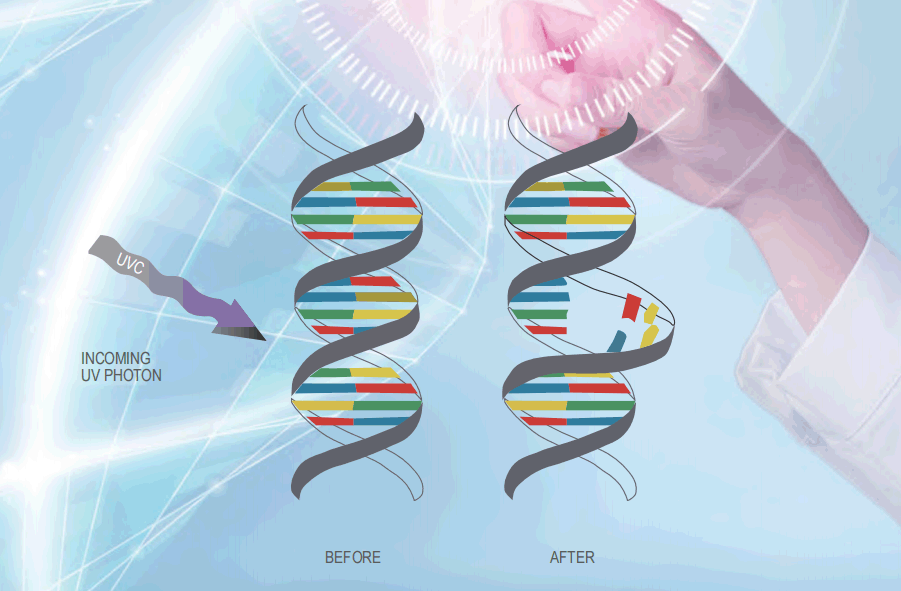
Plants have been exposed to solar UV radiation throughout their evolutionary history and have developed sophisticated defense and adaptation mechanisms. UVA (315-400nm) and UVB (280-315nm) radiation trigger a range of physiological responses in plants, including activation of antioxidant defense systems, accumulation of secondary metabolites, and morphological adjustments.
Research has found that low levels of UV-B radiation are particularly effective in boosting phenolic compounds such as glucosinolates and flavonoids in plants. These compounds are not only the plant's "sunscreen" but also important sources of antioxidant nutrients in the human diet.
.webp "uv-led-in-horticulture-how-to-boost-quality--yield (2).jpg")
Band | Wavelength Range | Primary Biological Effects |
UV-A | 315-400nm | Organic matter accumulation, morphological regulation, disinfection |
UV-B | 280-315nm | Secondary metabolism regulation, stress resistance induction, pest suppression |
UV-C | 200-280nm | Pathogen inactivation, surface disinfection, preservation |
Research shows that UVA radiation exhibits neutral or mildly stimulatory effects on plant growth, while UVB radiation exerts pronounced effects on growth and biomass accumulation. The key is dosage—low-dose UVB induces defense responses (quality enhancement), while high-dose UVB causes stress (growth inhibition).
A 2025 study published in Biology confirmed that targeted LED spectra incorporating UV light and blue light (435nm) significantly enhanced both the quantitative and qualitative attributes of Stevia rebaudiana growth, demonstrating that strategic light management can markedly improve nutritional and commercial yields.
This is the most mature and commercially valuable application direction for UV LED in horticulture.
Anthocyanin and Antioxidant Accumulation: Ultraviolet light (particularly UVB) activates the plant's phenylpropanoid metabolic pathway, promoting the synthesis of secondary metabolites including anthocyanins, flavonoids, and phenolic acids. In strawberry and blueberry cultivation, UV-B supplementation increased anthocyanin content by 19%–27%. A 2025 study further confirmed that UV-B radiation plays a key role in enhanced secondary metabolite production.
Flavor and Aroma Enhancement: UV radiation influences the production of volatile organic compounds in plants. Research found that UV-B treatment enhanced the relative peak area of volatile secondary metabolites including C6-aldehydes, terpenes, and ketones—these compounds are the chemical basis of fruit and vegetable flavor and aroma.
Vitamin Content Enhancement: UVA radiation has been shown to elevate phylloquinone (vitamin K1) levels in indoor-grown crops.
Case Study — Stevia: A 2025 controlled experiment demonstrated that LED lighting incorporating UV spectra significantly enhanced the sweet compound content and overall yield of Stevia rebaudiana, proving that strategic light management can markedly improve nutritional and commercial value.
Case Study — Tomato: A three-year greenhouse trial found that LED lighting increased β-carotene in "Chocomate" tomatoes by 34.3% but reduced it in "Bolzano" by 18.5%. This reveals a critical insight: spectral strategies must be matched to cultivar characteristics—there is no one-size-fits-all solution.
.webp "uv-led-in-horticulture-how-to-boost-quality--yield (3).jpg")
This is the fastest-growing and most research-intensive application direction for UV LED in horticulture.
UV-B for Pest Suppression: A landmark 2025 study published in Pest Management Science systematically evaluated the effectiveness of UV-B LED in suppressing Western flower thrips on greenhouse tomatoes. The study found that 4-hour UV-B exposure significantly suppressed the hatching rate of thrips eggs, regardless of whether irradiation occurred during day or night, or from the top or bottom of leaves. The study concluded: "4 h exposure to UV-B possesses considerable potential as a pest management tactic".
UV-C for Disease Control: UV-C irradiation has been shown to enhance plants' natural resistance to pathogens and diseases. In barley powdery mildew control, LED UV-C treatment was more effective than mercury lamp UV-C treatment.
Strawberry Anthracnose Control: A 2025 study using LED UV lamps at different wavelengths (280nm, 308nm, 330nm) found that 280nm irradiation provided the best control of strawberry anthracnose.
222nm Far-UVC Frontier: Research shows that 222nm far-UVC is 3 to 10 times more effective than conventional 254nm UV-C in killing strawberry fungal pathogen spores, without causing damage to strawberry plants. This finding has significant implications for both postharvest disease management and field disease control.
Industry Developments: At the 2025 GreenTech Amsterdam exhibition, ams OSRAM demonstrated a UV-C robotic arm for greenhouse disinfection and weed control, along with drones and algae reactors integrating UV-C LEDs. ams OSRAM explicitly stated: "UV-C light positively influences a variety of key parameters—it facilitates pest and disease control, accelerates growth rates, boosts crop yields, and improves both nutrient uptake and plant resistance to pathogens".
.webp "uv-led-in-horticulture-how-to-boost-quality--yield (5).jpg")
Postharvest loss is a major contributor to global food waste. UV LED is emerging as a non-thermal, chemical-residue-free preservation technology.
A 2026 review published in Plant Signaling & Behavior noted: "LED and UV-LED technologies provide a versatile, non-thermal platform for postharvest preservation, enabling wavelength-specific control over microbial safety, senescence, and the accumulation of health-promoting metabolites".
Intermittent UV-C Irradiation Innovation: A 2025 study presented at the ISAEB International Conference systematically investigated the mechanisms of intermittent UV-C LED irradiation for fresh fruit preservation. The experiment used 270-280nm high-power gallium nitride (GaN)-based UV-C LED chips. The results were striking:
Under ambient conditions (22-27°C) , 75% duty cycle UV-C irradiation (45s on/15s off) completely inhibited mold growth on apple slices and raspberries
Under 4°C refrigeration, the 25% duty cycle mode (15s on/45s off, 40cm distance) reduced raspberry spoilage rate from 100% to 20%
However, the study also found that while strawberries completely suppressed mold growth, they exhibited significant oxidative damage (44.4% of fruits showed water-soaked spots) and higher weight loss rates
This case reveals a core principle: UV-C preservation requires precise balancing between germicidal efficacy and quality maintenance—optimal parameters vary dramatically across fruit types.
Research on mangoes similarly confirmed that UVC treatment effectively extends the shelf life of mangoes with fewer initial infection symptoms.
Summary: The commercial value of UV LED postharvest preservation lies in the fact that extending shelf life by just one day can reduce losses by 10%–20%. For high-value fruits (berries, cherries, tropical fruits), the economics are compelling.
.webp "uv-led-in-horticulture-how-to-boost-quality--yield (6).jpg")
Compared to UVA-LEDs and UVC-LEDs, UVB-LED technology maturity is relatively lower, which has limited its large-scale application in horticulture.
Key challenges include:
Lower Wall-Plug Efficiency (WPE): UVB-LEDs generally have lower WPE than UVA-LEDs and visible-light LEDs
Lifespan and Reliability: UVB-LEDs face more severe reliability challenges in high-temperature, high-humidity greenhouse environments
Cost: UVB-LED chip manufacturing costs remain significantly higher than UVA-LEDs
But breakthroughs are happening. With continued optimization of epitaxial growth technology and chip structure design, UVB-LED performance is improving rapidly. From 2024 to 2025, commercial UVB-LED optical power density has shown significant improvement. The industry expects UVB-LED WPE to double within the next 2-3 years, which will dramatically reduce system costs for horticultural UV supplementation.
.webp "uv-led-in-horticulture-how-to-boost-quality--yield (7).jpg")
Traditional horticultural UV sources primarily use fluorescent lamps (UV-B fluorescent) and mercury lamps (UV-C mercury). UV LED advantages in horticultural scenarios are evident:
Comparison Dimension | UV LED | Conventional Fluorescent/Mercury |
Wavelength Selectivity | ✅ Precise single band (±2nm) | ❌ Broad spectrum with ineffective wavelengths |
Efficiency (WPE) | UVA 30-50%, UVC 5-10% | Fluorescent 5-15%, Mercury 8-15% |
Lifespan | 20,000-50,000 hrs | 5,000-10,000 hrs |
Heat Radiation | Low (cool light source) | High (IR heat radiation) |
Instant On/Off | ✅ Instant start | ❌ Warm-up required |
Mercury Content | ✅ Mercury-free | ❌ Contains mercury |
Dimming Capability | ✅ Precision dimming | ❌ Limited dimming range |
Selection Recommendation: For plant factories and greenhouse supplementation requiring precise spectral control, UV LED is clearly the optimal choice. For large-scale outdoor field applications, cost remains a constraint, but the gap is narrowing rapidly—UV LED equipment prices have dropped over 30% since 2024.
The core advantage of UV LEDs lies in wavelength selectivity—the ability to emit specific wavelengths precisely, rather than the broad-spectrum output of mercury lamps. This makes the concept of "Light Recipes" possible: designing optimal UV illumination schemes for different crops, different growth stages, and different quality targets.
A 2025 study published in Scientific Reports compared two UVA-LED illumination modes on indoor-grown lettuce. Mode 1 achieved a 99.90% disinfection rate while promoting organic matter accumulation, manifested as increased leaf area. The study demonstrated that UV-LEDs can serve not only as disinfectants but also as positive regulators of plant growth.
Plant factories (fully artificial light-based plant cultivation systems) represent the ideal scenario for UV LED applications—fully controllable environments make precise UV regulation possible.
In China, plant factories have already begun exploring UV applications in practice. Beijing Pinggu's "Aerial Nursery" project implements "AI light recipes" and time-sharing supplemental lighting strategies, utilizing off-peak nighttime electricity rates for high-intensity supplementation, achieving approximately 18% electricity savings per crop cycle; while using UV disinfection and ion-selective sensors to achieve over 90% nutrient solution recycling rates.
A 2025 master's thesis investigated the effects of pre-harvest LED side UV-A and far-red supplementation on hydroponic lettuce growth and quality under plant factory conditions. Results showed that pre-harvest UV-A supplementation effectively improved the quality indicators of hydroponic lettuce.
A 2025 study from Foshan University further confirmed that strategic UV-A supplementation in plant factories can significantly enhance crop nutritional quality without sacrificing yield.
2025 was a breakout year for UV LED horticultural application research:
《Pest Management Science》 published UV-B LED study on Western flower thrips suppression
《Journal of Sustainable Agriculture and Environment》 published UV-LED horticulture applications review
《Scientific Reports》 published UVA-LED lettuce disinfection and growth promotion study
《Journal of Plant Pathology》 published UV-C LED vs. mercury UV-C comparison for barley powdery mildew control
Multiple studies confirmed UV-B's key role in secondary metabolism regulation
ams OSRAM showcased a complete horticultural lighting portfolio at GreenTech 2025, covering full wavelength coverage from Hyper Red to Far Red to Deep Blue. Its next-generation OSCONIQ® P 3737 GEN 2 achieved 82.4% total efficiency and 6.09 µmol/s photon flux in the Hyper Red band, with 3.2% more performance and 2.2% higher efficiency than the previous generation. More importantly, ams OSRAM has clearly positioned UV-C LEDs as a strategic direction for horticulture, emphasizing their value in pest and disease control, yield improvement, and plant stress resistance enhancement.
Cree LED launched its Photophyll™ Select technology for horticultural lighting in 2025, with plans to extend it to more product lines and introduce additional green-blue-red (GBR) ratio options.
The DesignLights Consortium (DLC) updated its horticultural lighting technical requirements in 2025, further raising efficacy and quality standards for LED products in controlled environment agriculture (CEA) . This move will accelerate the Elimination of low-efficiency products and create greater market space for high-performance UV-LED products.
.webp "uv-led-in-horticulture-how-to-boost-quality--yield (8).jpg")
Metric | Data |
Global LED Grow Light Market (2025) | ~USD 4.5–5.8B |
Global Horticultural Lighting Market (2025→2032) | USD 2.1B→9.4B (CAGR 23.5%) |
LED Horticulture Market (2025→2030) | USD 2.37B→4.36B (CAGR 12.97%) |
Global Artificial Light Cultivation Market (2026) | USD 24.86B (+17.1% YoY) |
LED Plant Lighting Efficacy (2025-2026) | 4.2 μmol/J (+68% vs 2020) |
UV-B Berry Anthocyanin Enhancement | 19%–27% |
UV-C LED vs Mercury UV-C (Barley Mildew) | LED more effective |
222nm vs 254nm (Strawberry Fungi) | 3–10× more effective |
For UV LED Chip/Package Manufacturers:
UVB-LED is the next technology frontier. Current UVB-LED WPE and lifespan remain bottlenecks—companies that achieve breakthroughs first will dominate the horticultural quality regulation market
Monitor 222nm Far-UVC potential in agriculture—stronger germicidal efficacy with less plant damage could become the next-generation standard for horticultural UV sources
Collaborate with plant physiologists to develop "Light Recipes" —providing light sources alone is no longer enough; spectral solutions are required
For System Integrators/Luminaire Manufacturers:
Shift from "general supplementation" to "crop-specific light recipes"—different crops and cultivars respond dramatically differently to UV; customization capability will become a core competitive advantage
Focus on plant factories and vertical farming—fully controllable environments are the ideal scenario for precision UV regulation
Postharvest preservation is a low-barrier, high-return entry point—cold storage UV-C retrofits have short project cycles, quick results, and short customer decision chains
For Growers/End-Users:
Start with small-scale trials—UV supplementation effects are highly dependent on cultivar, growth stage, and environmental conditions; validate at small scale before scaling up
Focus on TCO rather than initial investment—quality improvement premiums often far exceed equipment costs
Pay attention to DLC and other certification standards—select products that meet the latest efficacy and quality standards to mitigate long-term risks
.webp "uv-led-in-horticulture-how-to-boost-quality--yield (9).jpg")
UV LED applications in horticulture and agricultural technology are at an inflection point—transitioning from "academic exploration" to "commercial scale-up." In 2025, three forces converged to accelerate this field: concentrated academic research breakthroughs, accelerated industry deployment by market leaders, and gradual establishment of standards systems.
Unlike the "replacement logic" of UV LED in disinfection, the core of horticultural applications is "value creation"—using precise spectral regulation to make crops taste better, more nutritious, more shelf-stable, and more disease-resistant. This is an upgrade path from "yield" to "quality," with higher commercial margins and greater differentiation potential.
Water treatment is UV LED's largest market; horticulture is UV LED's most imaginative market. For industry participants across the value chain, now is the strategic window to establish a position in the horticultural sector.
Next Issue Preview: Issue #11 will focus on UV LED in Medical Phototherapy and Aesthetics, exploring the latest advances in UVB phototherapy for psoriasis, vitiligo, and other skin conditions, as well as the rise of the home-use UV beauty device market.
#UVLED #Horticulture #PlantFactory #AgTech #CEA #LEDGrowLight #LYDElectronics


 English
 русский
 日本語
日本語 한국어
한국어 français
 Deutsch
 Español
 português
 العربية
 italiano
 Nederland